Mics that add up, instead of cancelling.
Two mics on one drum, or a bass recorded by DI and amp, hear the same note at different times, and sometimes in opposite polarity. Summed, they cancel: the snare loses its body, the kick and the bass their bottom end. TapeLeader measures every pair on the hits, proposes a fix with the reason in numbers, switched on, and lets you compare it by ear and change it.
In the app: the Align window, the Align column of the main window, and the ALIGN card in PROCESS and in the miniMix.
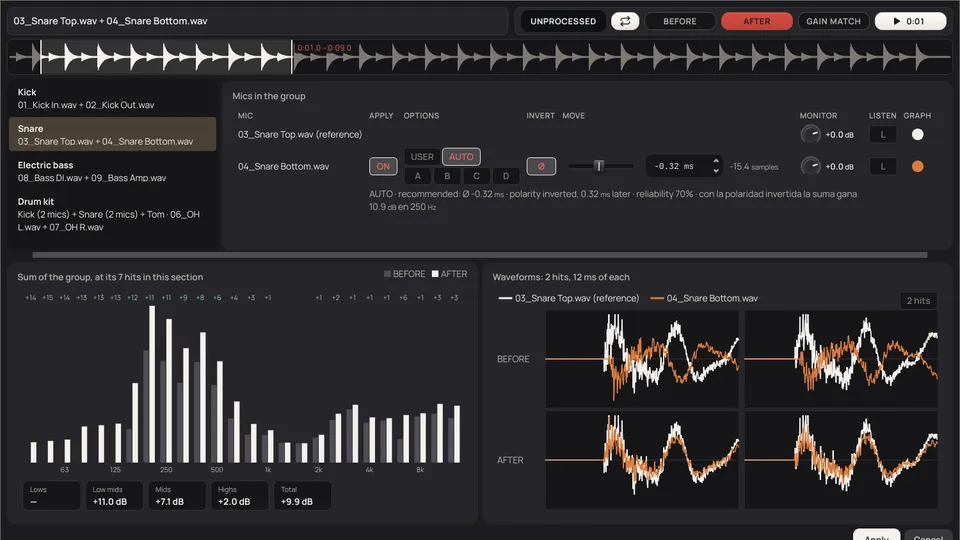
Body where it was missing.
Four things change when the kit and the bass are aligned. Each figure comes from a real session.
- The snare gets its body back
The bottom mic faced the other way and arrived late. Inverted and moved 0.32 ms, 95 % of the hits sum louder.
+9.8 dBat 125 Hz in the sum of top and bottom, measured on the hits. - The kick's other mic, in time
A kick out mic a metre away arrives milliseconds late. Align looks up to 6 ms away and offers the move that lines the attacks up.
0.08 msbetween one of its options, 3.36 ms, and what Iván had set by ear, 3.44. - Overheads that land with the kit
The overheads hear every drum late. They are moved once, as a pair, by what it takes the snare to reach them, so the attacks land together.
2–3.6 mshow far the overheads moved in six of the eight sessions we measured; in the other two they couldn't be measured and stayed put. - The bass, DI and amp as one
The amp arrives after the DI, through a speaker and a mic that turn the phase. Lined up, the two stop eating each other's low end, and the weight of the bass comes back to the mix.
+8.9 dBat 125 Hz in the sum of DI and amp with option D: inverted, 0.74 ms and the phase turned at 77 Hz. The plain move loses 7 dB at 63 Hz; the turn brings it back to −0.5.
BEFORE, AFTER, and GAIN MATCH.
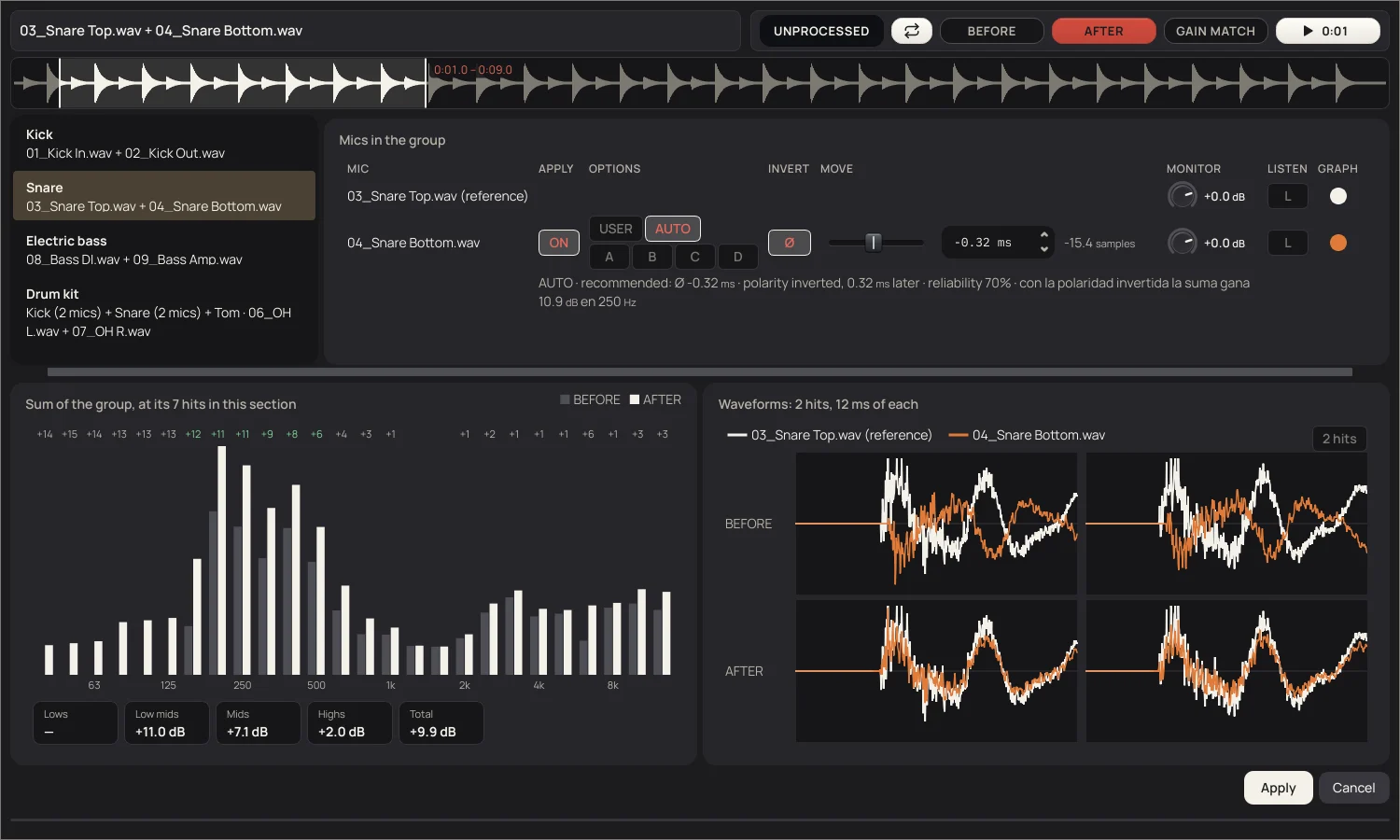
The Align window shows the sum of the group by bands and two hits as waveforms, BEFORE and AFTER. GAIN MATCH raises BEFORE to the loudness of AFTER, so what you compare is the body, not the level. Here it starts off, because the level the sum gains is the result.
AFTER · the snare mics in polarity, bottom moved 0.32 ms
Drawing: the sum by bands, measured on the hits, and two hits, BEFORE and AFTER. The figures are from one real session; the Align window, on its 8-second stretch, shows 5.3 dB at 125 Hz.
Measured on the hits, three ways.
For each group of mics on one source (kick in and out, snare top and bottom, bass DI and amp, several mics on one amp) one mic is the reference and every other is measured against it. The first two ways compete and the one that makes the sum gain more wins; the third comes in when neither gives a fix worth keeping.
Polarity first, then time.
What an engineer would try first: flip it and listen. The sum is compared hit by hit with the mic as it is and inverted. If inverted gains at least 1 dB, on 7 hits out of 10, it is inverted; then a fine move of less than 1 ms, only if it adds something.The case of a snare top and bottom.
Delay and polarity together, from the attacks.
A correlation of the attacks, accurate to a fraction of a sample. It is right when the mics are at different distances.Bass DI and amp, kick in and out.
By the sum.
What you do with the milliseconds knob: slide the mic up to 2 ms and stop where the hole in the mids fills without losing the lows. Each octave counts by how loud it sounds, not by its energy, so 3 dB more at 500 Hz counts even when the lows don't change.
On a kick, three zones may not lose more than half a dB: the fundamental, the knock around 0.7–1.5 kHz and the click from 4 kHz up."moving it, the sum gains 3.0 dB at 500 Hz"
Then far, up to 6 ms.
Two metres between mics. A big move replaces a small one only if it clearly gains more. When the best move falls where the attacks say, two different measurements agree: that is the real delay between the mics, and it is proposed with the attacks together.
It only proposes what improves the sum.
- No attacks to measure, already aligned, or a measurement it can't trust: no proposal, and the controls stay at zero for you.
- If the sum doesn't improve, or any band you can hear loses more than 1 dB (2 dB when the move is exactly where the attacks line up), it is left out. A band 20 dB under the loudest one can't veto a move, and counts very little in its favour.
- Every proposal says whether it inverts, how many milliseconds it moves, and how many dB the sum gains, and for most, where. (For now, the English app shows these reasons in Spanish.)
Options you switch while it plays.
Each mic has several sums that work. You switch between them with one button, playing, the way you switch BEFORE and AFTER, and keep the one you like.
- USER
- Yours: what the Ø and the milliseconds say. The only one you edit.
- AUTO
- The recommended one, with its reason.
- A B C D
- Other sums that also gain, each a different way: best move without inverting, best inverting, polarity only, and on kick and bass the recommended one with the phase rotated.
- Click twice
- On the option that is playing: back to the one before. AUTO, yours, AUTO, yours, without moving the mouse.
- Ø · Move
- Polarity, and a move of ±5 ms with the knob (±20 ms typed). Touching them copies the option into USER.
- Zones
- Lows, Low mids, Mids, Highs and Total: where the sum changes and by how much. Whether it sounds better is for your ears.
- PROCESSED
- Judge the sum with each mic already processed (gain, HPF, Clipper, FX Chain), with the alignment on top. It comes on by itself when a mic in the group has an FX Chain.
The whole kit, against the overheads.
The groups above are each source's own mics. The Drum kit is every source as a whole, with the overheads as the reference, in this order:
The overheads move once.
The pair, together, by what it takes the source they carry best to reach them, nearly always the snare. The attacks land together without moving the drums against the bass and guitars. If it can't measure it well, it doesn't move them and says so.
Then the polarity of each source.
With the overheads moved, a source is inverted if that gains at least 1 dB of body, on 7 hits out of 10, without its lows losing more than 2 dB. All its mics flip together. The overheads are never inverted.
A time tweak, only if it earns it.
Each source's own move comes set only if it measures well and gains body. If not, its row says how many milliseconds its attack asks for, so you can try them.

Bass DI and amp, and the kick: phase rotation, as an option.
- Sometimes moving and inverting isn't enough: DI and amp line up in one part of the lows and cancel in another, because amp, speaker and mic turn the phase differently at each frequency.
- Then one of the options adds an all-pass on the mic, which turns the phase in the lows without changing any level, like a Little Labs IBP. It is offered on kick and bass, only if the sum gains at least 1 dB in a low octave and loses no more than half a dB in any other. In the table: D Ø −0.74 ms φ 77 Hz.
- It never goes in by itself. Sometimes it sounds better, sometimes just different: that is a choice for your ears.
[MANUAL: chapter 9.1, Phase and polarity alignment] The whole chapter, with every control, is in the manual.